Almost every Gastonia house has a green side. It is the north-facing wall, the side shaded by trees, or the stretch behind shrubs where air barely moves. The tint is usually algae, sometimes mildew, and it returns on a schedule that frustrates homeowners who just paid to have it blasted off. Around that frustration, a set of myths has grown up: that bleach alone fixes it, that more pressure fixes it, that green means the siding is rotting.
Sorting those claims matters because the wrong fix wastes effort and can damage siding. Algae is a surface organism that feeds on moisture and the dust and pollen that settle on a wall. Kill the organism and rinse the residue gently, and the wall stays clean far longer than if you simply strip the color off and leave living spores behind in the texture of the siding.
Why the north side, and why it keeps coming back
Sunlight is the main control. South and west walls dry quickly after rain and dew, so algae struggles to establish. North walls in the Piedmont can stay damp through a whole humid morning, and shade from trees or a neighboring house extends that window. Add spring pollen, which coats everything in Gastonia for weeks, and the wall has both moisture and food. Gutters that overflow and shrubs planted tight against the siding make it worse by keeping the surface wet and the air still.
That is also why the green often appears in a band low on the wall or under a drip edge. Splash-up from mulch beds wets the bottom courses, and a leaking gutter joint paints a vertical stripe of extra moisture. Treating the growth without fixing the water source buys a shorter result, no matter how good the cleaning was.
The claims, sorted
| Claim | Verdict | Why |
|---|---|---|
| More pressure removes algae for good | False | Blasting strips the color but leaves living cells in the siding texture, and high pressure can force water behind the laps. |
| A treatment wash lasts longer than water alone | True | Killing the organism, not just rinsing it, delays regrowth by months compared with a plain water wash. |
| Green algae means the siding is rotting | It depends | On vinyl and fiber cement, algae is a surface issue. On wood, long-term damp can hide real decay underneath, worth checking. |
| Trimming shrubs and fixing gutters helps | True | Airflow and faster drying remove the moisture algae needs. Growth returns slower on walls that dry out each day. |
| Once cleaned, a shaded wall stays clean for years | False | In humid Piedmont summers, a heavily shaded north wall may show new growth in a season or two even after proper treatment. |
| You can scrub a small patch by hand | True | A soft brush, detergent solution, and a hose rinse handle a small area behind a shrub. Large walls are ladder work and belong to a pro. |
Treatment versus blasting, in practice
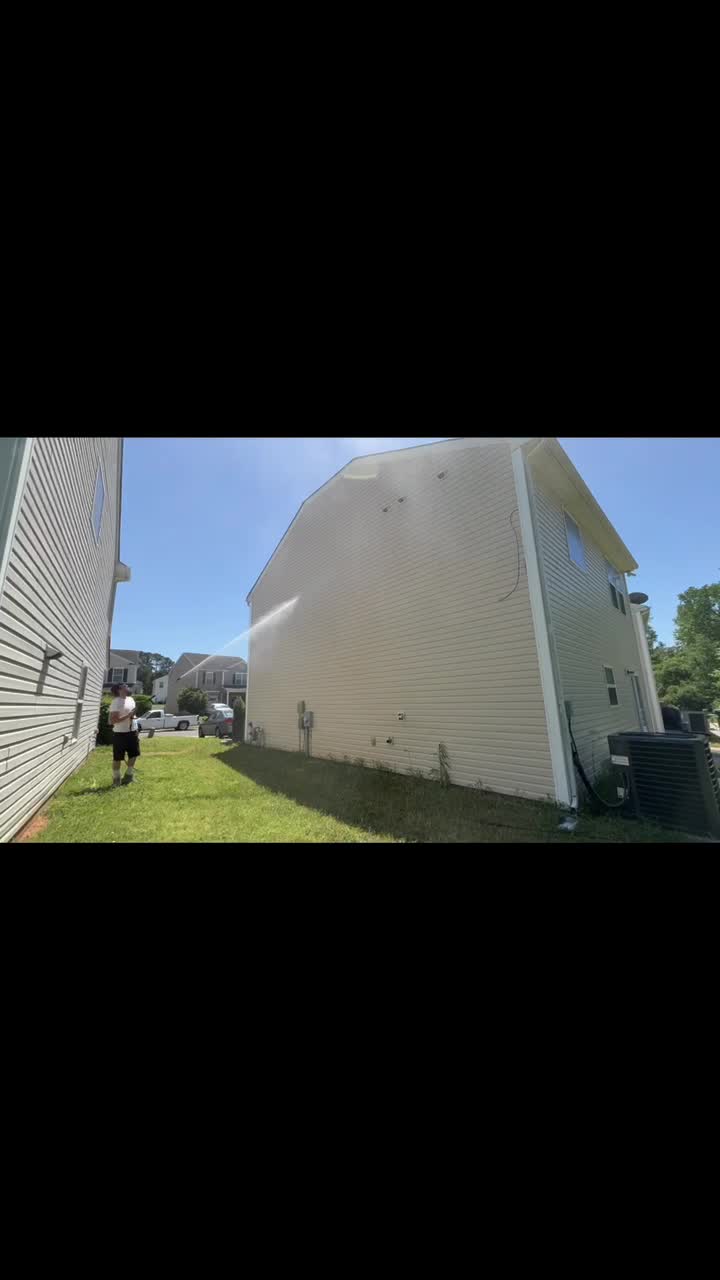
A treatment-based wash, often called soft washing, applies a cleaning solution at low pressure, gives it time to kill the growth, then rinses gently. The siding is never hit with the kind of pressure that lifts paint or drives water upward behind the laps. For homeowners, the practical test after a wash is simple: run a hand over the cleaned wall when it dries. A properly treated wall feels clean. A blasted wall often feels chalky or rough where the surface was eroded, and the green tint returns first in exactly those roughened spots.
There are also places to keep solution and rinse water in mind. Cover or rinse down sensitive plants before and after, keep the work away from open windows, and never mix cleaning chemicals on your own. Professionals, including Novelli Pressure Washing LLC, plan for plant protection as part of the job rather than an afterthought.

Slowing the return
After cleaning, small changes stretch the interval. Trim shrubs back so a gap of air sits between foliage and siding. Fix gutter overflows and downspouts that dump near the wall. Rinse heavy pollen off shaded walls with a garden hose during spring, which takes minutes and removes the food source before algae gets established. None of this makes a north wall maintenance-free, but together it can turn an every-year problem into an every-few-years one.
Common questions
Is the green growth on my siding dangerous?
Algae on siding is mostly a cosmetic problem and a sign of persistent damp. The bigger concern is the moisture itself, especially on wood siding, where long-term damp can lead to decay.
How often does a shaded wall need washing?
It depends on shade and moisture, but heavily shaded north walls in this region often need treatment every one to three years. Walls that dry daily can go much longer.
Can I just use a pressure washer I own?
For a small, reachable area with a wide fan tip and low pressure, careful work is possible. The common mistakes are too much pressure, working from a ladder with a wand, and skipping the treatment step, which is why the green returns quickly.
← All guides from Novelli Pressure Washing LLC← Back to Novelli Pressure Washing LLC